PM Modi’s jackets, Rahul’s shirts, Mamata’s sarees: How leaders use fashion for political messaging

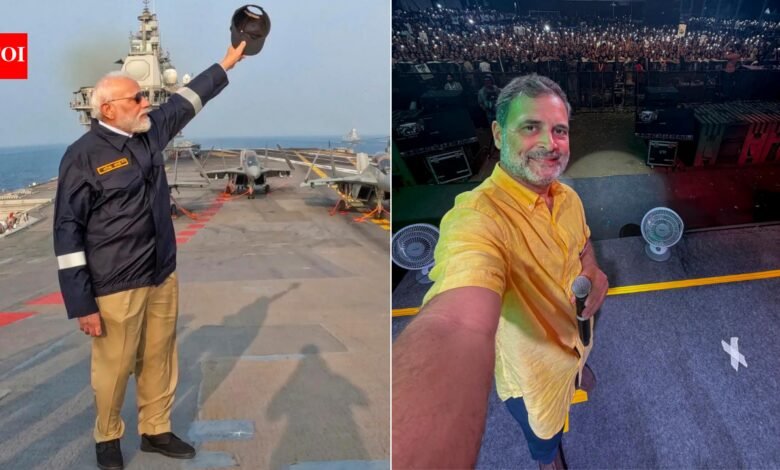
From Indira Gandhi’s sarees to Narendra Modi’s carefully curated bandhgalas, from Rajiv Gandhi’s sneakers and sunglasses to the Thackerays’ colour-coded political imagery, what Indian politicians wear has often been more than a question of personal style. Their clothes have helped construct identities, signal ideology, project modernity, invoke tradition and increasingly generate the kind of visual moments that social media loves.So when Rahul Gandhi appeared in a pink shirt and later in a yellow one, the change from his usual white clothing drew attention online. The yellow shirt, along with the line “Smash the patriarchy”, became part of the social-media conversation. The interest was less about the shirt itself and more about how unusual it looked compared with his regular public appearance.But this is not the first time that a politician’s attire has made more headlines than their speech. Prime Minister Narendra Modi’s clothes have often drawn attention, from his signature jackets and bandhgalas to the regional outfits he wears during visits across the country. Over the years, they have become a familiar part of his public image.As designer Gaurav Jai Gupta puts it, “Fashion can communicate before a politician has spoken a single word. Clothing conveys identity, ideology, relatability, authority and even regional or cultural affiliation almost instantly.” Politics, he adds, is fundamentally about perception, and “an outfit can become the visual shorthand for an entire political moment.
PM Modi: How his wardrobe became part of his public image
Prime Minister Narendra Modi has taken political dressing into the era of personal branding.His wardrobe moves easily between traditional Indian clothing and sharply tailored modern silhouettes. The signature kurta, sleeveless jackets and bandhgalas have become instantly recognisable, while his international appearances often combine Indian craftsmanship with global tailoring.Some of the looks have become headline-makers in their own right.In January 2015, during his meetings with then-US President Barack Obama, Modi wore a pinstriped bandhgala whose stripes, on closer inspection, repeatedly carried his full name — “Narendra Damodardas Modi” — embroidered into the fabric.
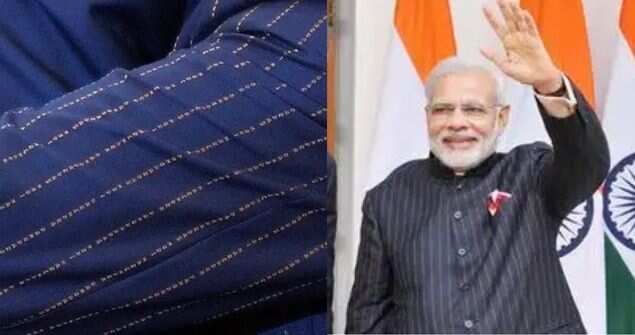
PM Narendra Modi in the monogrammed suit that drew global attention
His wardrobe has since offered plenty of other visual moments.A burgundy bandhgala during his first overseas trip as prime minister created a polished diplomatic look. A signature khadi kurta during his Bhutan visit emphasised Indian textiles and craftsmanship. In Nepal, saffron attire paired with a rudraksh mala made a strong cultural and religious statement at Pashupatinath Temple.This habit of dressing for the country he’s visiting — or the region of India he’s in — is itself a strategy, according to Gupta: “I would definitely consider it a form of fashion diplomacy. Clothing can be a very subtle way of acknowledging the culture of the country you are visiting while siultaneously representing your own identity.” Retaining elements of one’s own traditional identity alongside that, he says, “reinforces national representation.“His recent looks have been more state-centric. From sporting the gamcha look in Bihar, to a turban in Punjab, and even the traditional mund in Kerala, Modi has worn his “vocals for locals” tag.
Pink, yellow, blue – Rahul’s pattern?
For years, Rahul Gandhi’s public wardrobe has largely stayed within the safe territory of political dressing — white kurta-pajamas, jackets and understated casual wear. It is a familiar uniform in Indian politics, one that keeps the focus on the politician rather than the clothes.But the pink and yellow shirts were different.Bright, instantly noticeable and far removed from the monochrome political wardrobe, they became an unlikely talking point. Gupta explains why a single garment can take on a life entirely of its own online: “The internet loves symbols that are simple, recognisable and easy to reproduce. A yellow shirt is, in itself, just a yellow shirt. But once social media attaches a narrative to it, the garment can acquire an entirely new meaning.” The audience, he says, effectively co-authors the outfit’s significance — “memes, edits, captions and commentary can transform an ordinary look into a cultural reference point,” helped along by the fact that “colour is highly emotional and visually immediate.”
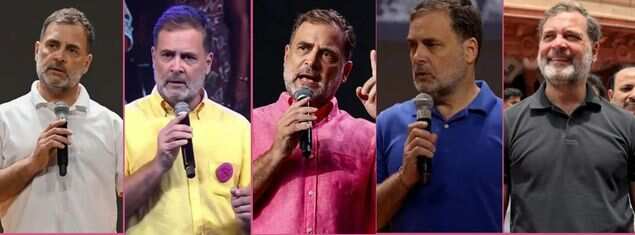
Rahul’s shade of politics through the years
He did not wear it just anywhere, either. He wore it to the ‘Chhatron ki Goonj’ programme, where the audience was predominantly Gen Z. But this is not the first time the Leader of Opposition has made news for his fashion. In 2019, Rahul attended a Kerala college event in a t-shirt and jeans, taking a break from his classic white kurta look, with his “You can call me Rahul” reels still going viral.Likewise, it was not a conincidence that he went with a blue t-shirt, when he held up the red book in his hand and said “Save the Constitution”, or a black one to protest outside the Parliament.It’s a pattern. Every Rahul Gandhi’s politics has reflected in his preference for colours.
Indira Gandhi: The saree that became a power statement
Long before politicians had to worry about going viral, Indira Gandhi had already mastered the art of having a recognisable political look.Her sarees, from Banarasi silk to handlooms and Tanchois, became an important part of her public image. They projected tradition and authority at the same time, allowing her to appear deeply rooted in Indian culture while commanding political spaces at home and abroad.The saree wasn’t simply a sartorial choice. The way she wore it, with the pallu covering her head from the loose end of the saree, made it distinct.
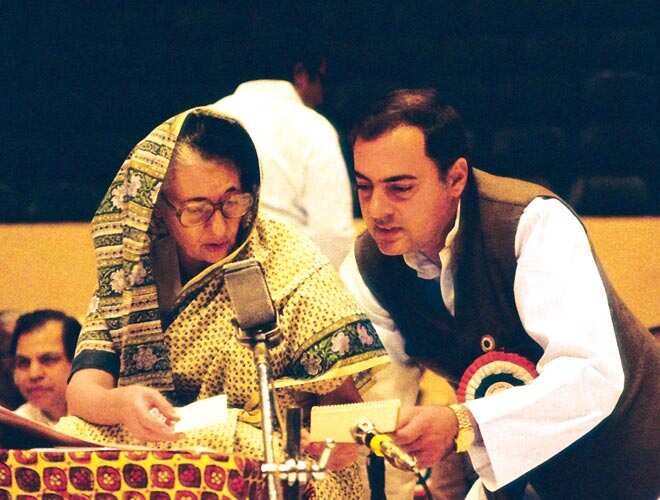
Indira Gandhi in one of her signature sarees during a public event
Gupta points to exactly this kind of repetition as the foundation of a political fashion identity: “Consistency is the key to creating a fashion identity. When a politician repeatedly wears a particular silhouette, colour palette, accessory or garment, it becomes part of their visual vocabulary.” Indira Gandhi’s sarees, he notes, “became inseparable from her public image,” much “like branding in fashion or advertising: repetition creates recognition.” Eventually, he says, “you don’t need to see the entire person; a particular silhouette, colour combination or accessory can be enough to trigger recognition.” But he’s careful to add a caveat: “successful political style usually feels authentic rather than overly constructed. The strongest personal brands emerge when the clothes reinforce something the politician already represents.”For women in politics especially, clothing has always carried an extra layer of scrutiny. Too traditional, and a leader can be boxed into convention. Too Western, and questions about cultural authenticity can follow.Moreover, most female political leaders of the time or the ones who preceeded her wore sarees the same way.Indira’s style largely sidestepped that binary. She made traditional Indian clothing look powerful.
Nehru’s jacket, Rajiv’s sneakers: Political wardrobe evolves
The political fashion story goes back even further.Jawaharlal Nehru’s iconic jacket became so closely associated with him that his name effectively became part of the garment’s identity. The jacket was a descendant of the northern Indian achkan, a closed-neck, coat-like garment traditionally associated with Indian nobility. It was largely when the style was marketed to Western audiences that it took the “Nehru” name, after the prime minister popularised it through his public appearances. The minimalist look later found fans beyond politics, including the Beatles and Sammy Davis Jr, who reportedly owned more than 200 Nehru jackets.
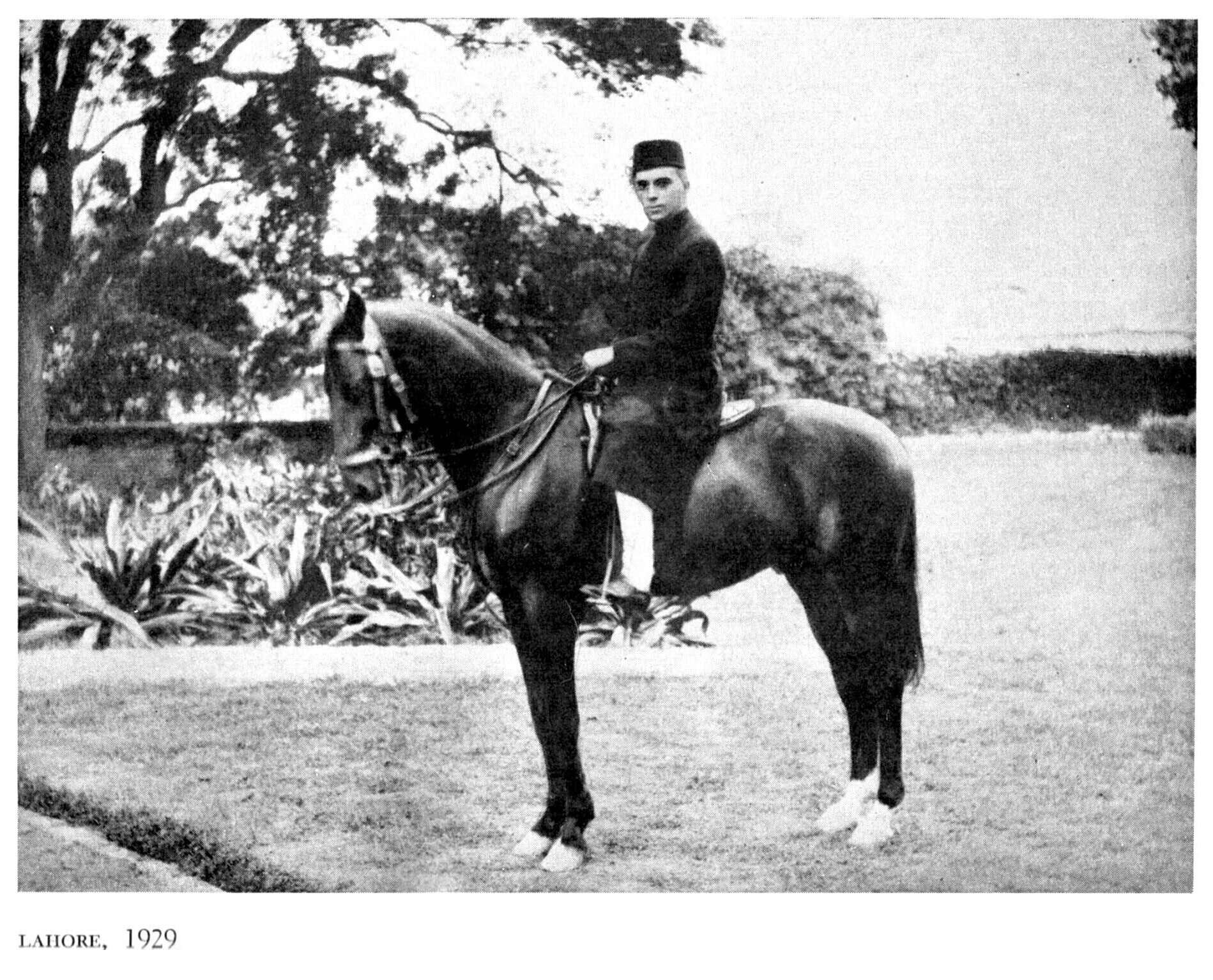
Jawaharlal Nehru in his signature Nehru jacket, which later became a global fashion symbol
Khadi and handlooms carried an even bigger political history, associated with nationalism, self-reliance and the freedom movement.Then came Rajiv Gandhi.Dark sunglasses, sneakers, sleeveless fleece jackets and khadi kurta-pajamas gave him a distinctly more contemporary appearance. His wardrobe reflected the image he projected politically — younger, modern and more comfortable with the technological future.
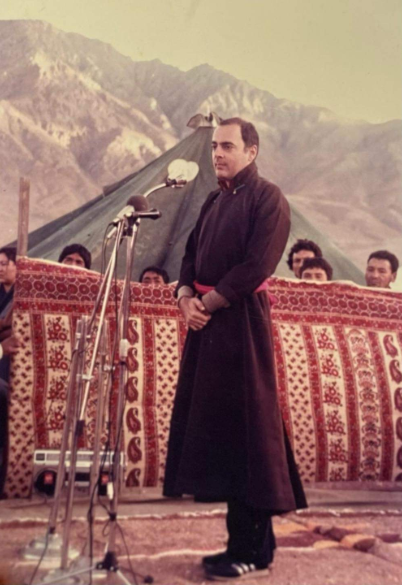
Rajiv Gandhi sporting a pair of sneakers
In other parts of the world, political leaders also turned their clothes into signatures. Mao Zedong’s four-pocketed tunic, known as the Zhongshan suit and later the Mao suit, became closely associated with communist China and was brought back into fashion during his rule. Usually seen in muted shades of grey, green or blue, the suit became a visual shorthand for Mao and communism before falling out of favour after his death in 1976.
The Thackerays: When colour carries politics
If PM Modi’s wardrobe demonstrates the power of personal branding, the Thackerays show how colour and clothing can become political shorthand.Bal Thackeray initially adopted the shirt-and-trouser look of the urban office worker, appealing to an aspirational Maharashtra audience. Later, as Hindutva became central to his political positioning, orange became a defining element of his public appearance.Fashion designer Nivedita Saboo, who has dressed several politicians, explains why colour carries this kind of political weight in the first place: “Colour communicates emotion before language does. Saffron can evoke spirituality, sacrifice, nationalism and Hindu cultural identity. White can communicate simplicity, peace, authority or the traditional Gandhian vocabulary. Electric or deep blue has powerful associations with social justice, equality and Ambedkarite politics.” But, she cautions, “colour is never universal. Its meaning changes with culture, history, political association, fabric, styling and even the person’s body language. That’s why political dressing is fascinating: you can say something without saying anything.”Uddhav Thackeray developed his own visual identity through simple, brightly coloured sadra-pajamas closely associated with Maharashtrian culture.
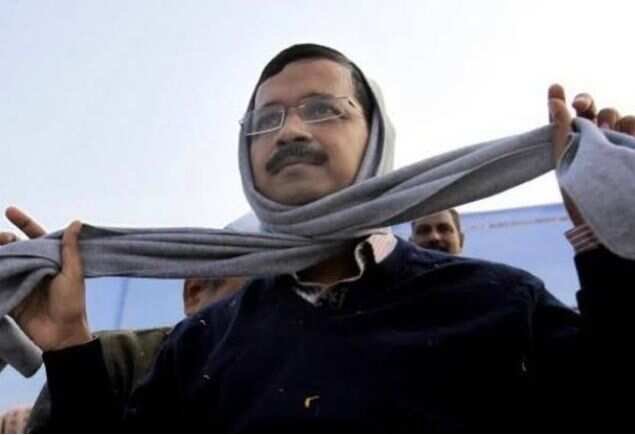
Arvind Kejriwal’s signature muffler became a recognisable part of his political image
In other parts of the world, political leaders also turned their clothes into signatures. Mao Zedong’s four-pocketed tunic, known as the Zhongshan suit and later the Mao suit, became closely associated with communist China and was brought back into fashion during his rule. Usually seen in muted shades of grey, green or blue, the suit became a visual shorthand for Mao and communism before falling out of favour after his death in 1976.
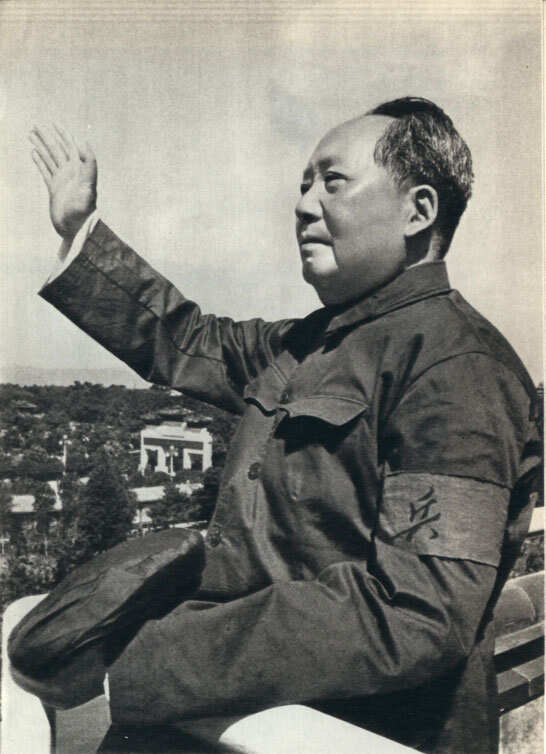
Mao Zedong’s uniform-like suit became a visual shorthand for his revolutionary politics
Fidel Castro, meanwhile, swapped the traditional military and political imagery for tracksuits later in life. He was famously photographed wearing a red, white and blue Adidas tracksuit while recovering from surgery in 2006. The look soon became part of his public image, with Castro later wearing sportswear from brands including Fila, Puma and Nike.
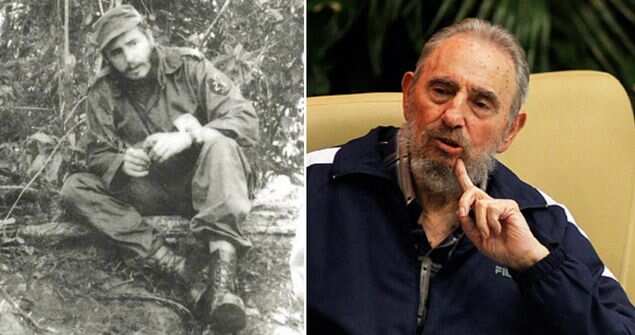
Fidel Castro in his guerrilla boots during his early political years (left); Castro in a tracksuit in his later years (right)
What would it take to dress for Gen Z?
If a yellow shirt at a college event can trend for days, the question naturally follows: what does it actually take for a politician’s wardrobe to land with a generation raised on Instagram and short-form video?Saboo, who has worked closely with politicians on exactly this brief, is blunt about the trap most of them fall into. “Gen Z has grown up in a visual culture where identity is communicated through what you wear,” she says. “But breaking the dress code simply to look young can backfire. Gen Z is extremely good at detecting what feels manufactured. The clothes have to feel like the person, not like a stylist has dressed them to look young.” A politician who “wears the traditional kurta beautifully and owns it completely,” she argues, can be “far more compelling than somebody wearing sneakers and a T-shirt because someone told them that’s what young people like.” For her, the real shift isn’t from tradition to trend — it’s “from dress code to personal code.”Asked to imagine one outfit that could say “young India” without a single slogan, she describes something quietly hybrid: a relaxed, engineered jacket in a lightweight Indian textile over a tapered trouser, perhaps a modernised kurta with sharper, almost architectural proportions underneath, finished with one unexpected element — an unusual seam, a technical fabric panel, a monogram, a contemporary sneaker.
Share your thoughts in the comments
Be respectful · TOI community guidelines
The palette, she says, would be “sophisticated rather than loud — ivory, charcoal, deep blue or earthy neutrals with one energetic accent.” The test, in her words: “It shouldn’t look like ‘politician trying to be fake and dress young.’ It should look like India’s next generation has naturally evolved its own version of Indian clothing.”Her advice to politicians boils down to five principles: don’t dress younger, dress more authentically; modernise proportions rather than identity; find one recurring signature — a colour, a silhouette, a jacket, a watch — rather than constantly changing the wardrobe; make sure the clothes actually function in a country that “lives fast”; and, above all, stop being afraid of personality. As she puts it, “politics has traditionally rewarded conformity. Gen Z is attracted to people who appear comfortable in their own skin.” Fashion, she concludes, “cannot manufacture relatability. It can only amplify it.”