



In India, the Foreign Contribution Regulation Act (FCRA) is one of those laws that returns to the spotlight every few years — often amid much clamour. But why? The law has repeatedly generated debate over how India should balance scrutiny of overseas funding with the autonomy of NGOs and other civil society organisations.The Foreign Contribution (Regulation) Amendment Bill, 2026, introduced in the Lok Sabha in March, proposes a new framework for managing foreign contributions and assets when an organisation’s registration is cancelled, surrendered or ceases. The government says the changes are intended to address administrative and legal gaps, while critics question the breadth of the proposed powers.The opposition, however, has argued that the proposed changes hand sweeping powers to the government and could allow it to take control of assets built over decades by charitable organisations.
CJP Jantar Mantar Protest Updates
The FCRA Bill treats minorities as enemies and is keen on snatching their properties.
DMK MP P Wilson
Several church groups, particularly in the Northeast, have argued that the changes could disproportionately affect Christian institutions that use foreign donations for welfare work.So, what exactly is changing, why has the Bill become controversial and what does it mean for thousands of organisations that receive money from abroad?
What is FCRA
The Foreign Contribution Regulation Act, popularly known as FCRA, governs how individuals, trusts, NGOs, associations and companies in India can receive and use money, securities or other contributions from foreign sources. Administered by the Amit Shah-led home ministry, the law does not prohibit foreign donations. Instead, it lays down who can receive them, how they must be accounted for and where they can be spent.The government has maintained that the purpose behind the tweaking of the legislation is to ensure foreign money enters India through a more transparent and accountable system so that it cannot be diverted towards activities considered “harmful” to national interest, democratic institutions or public order.
FCRA… ensures that foreign money enters India through a registered, accountable and disclosed channel… while enabling thousands of organisations to carry out legitimate, impactful work
Centre
Under the law, any organisation that wants to receive regular foreign funding must obtain an FCRA registration from the home ministry. For those receiving a one-time grant for a specific purpose can seek prior permission instead. Therefore, every rupee received has to pass through a designated bank account, be audited and be reported annually to the government.The law also bars election candidates, legislators, judges, government servants, newspaper editors involved in news reporting and political parties from receiving foreign contributions altogether.
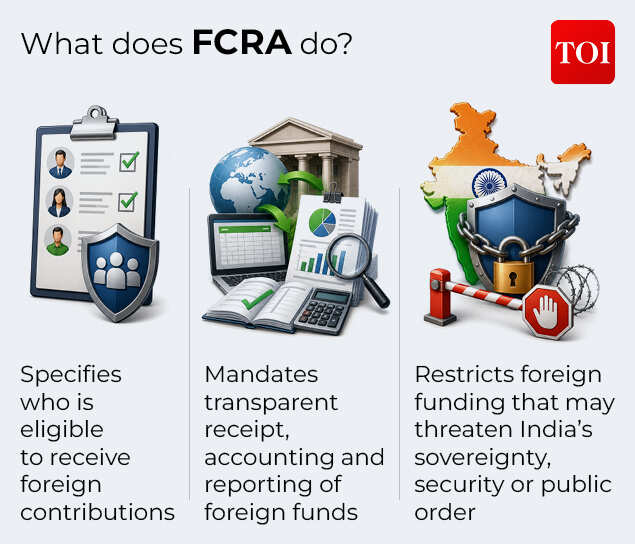
FCRA restricts foreign funding that may threaten India’s sovereignty.
The government argues that this is not unique to India. The home ministry has cited foreign-influence registration systems in the United States, the United Kingdom, Australia and Canada to argue that such oversight is not unique to India. However, these systems differ in scope and are not direct equivalents of the FCRA’s broader regulation of foreign contributions.
A law that has steadily become stricter
India first enacted the FCRA in 1976 during the Emergency era. Even then, the central concern was “foreign influence” over domestic politics and institutions.The framework was significantly overhauled in 2010, when Parliament replaced the old law with the present FCRA. One of the biggest changes was introducing a registration system valid for five years, after which organisations had to renew their licences.In 2020, the law underwent one of its most significant revisions, mandating the organisations receiving foreign funds to route all contributions through a single State Bank of India branch in New Delhi.
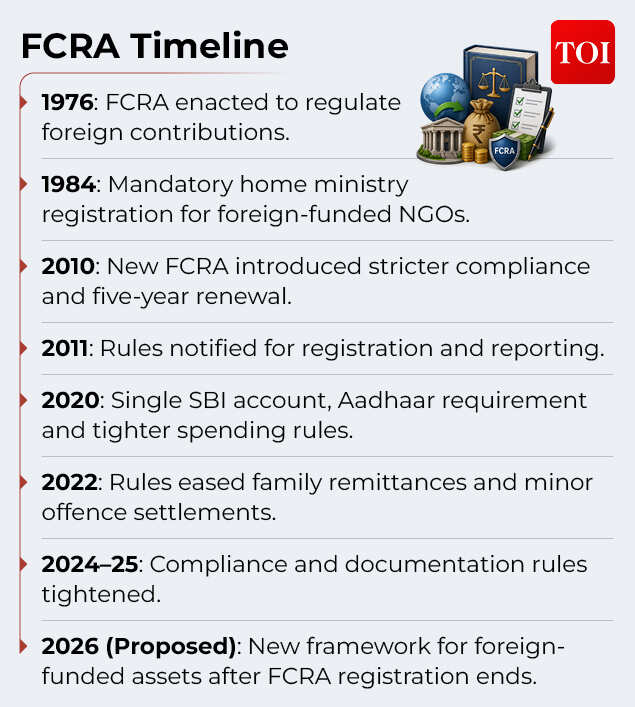
How FCRA steadily become stricter
The ceiling on administrative expenses was reduced from 50 per cent to 20 per cent. Organisations were also barred from transferring foreign funds to other NGOs, while office-bearers had to provide Aadhaar or passport details.Successive amendments have tightened both reporting requirements and operational restrictions. The 2026 Bill extends the framework beyond routine compliance to the management and disposal of assets when an organisation’s registration ends.
What the 2026 Bill proposes
The headline provision in the Bill concerns organisations whose FCRA registration comes to an end.At present, an organisation may lose its FCRA registration if the government cancels it for violating the law, if the organisation voluntarily surrenders it or if the registration is not renewed.The 2026 Bill formally introduces the concept of a certificate “ceasing” to exist. This would happen if an organisation fails to apply for renewal, misses the renewal deadline or if its renewal application is rejected.That change is significant because the Bill links the end of an FCRA certificate with what happens to foreign-funded assets.The proposed law creates a designated authority to take charge of foreign contributions and assets created using those contributions whenever an organisation’s registration is cancelled, surrendered or ceases.Initially, the transfer of assets will be provisional. If the organisation later succeeds in restoring or renewing its registration, the unutilised foreign contributions and assets will be returned.However, if the organisation fails to regain its registration within the prescribed period, the transfer becomes permanent.The designated authority will then have the power to manage those assets, transfer them to central or state government departments or dispose of them through sale. The proceeds from such disposal, along with any remaining foreign contribution, will be credited to the Consolidated Fund of India.
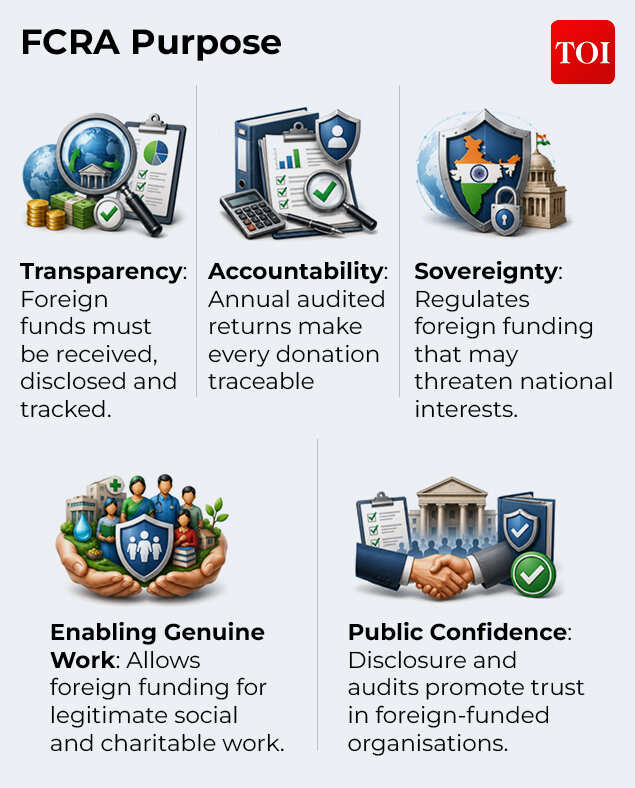
FCRA regulates foreign funding that may threaten national interest.
The Bill also formally defines “key functionaries” who can be held responsible for violations committed by an organisation. These include directors, trustees, partners, office-bearers and others responsible for managing the institution.It requires organisations receiving foreign funds through prior permission to receive and utilise those funds within a prescribed period.Interestingly, the Bill reduces the maximum punishment for violating the Act from five years’ imprisonment to one year, a move the government describes as a more proportionate approach to enforcement.Another provision says no investigation into an offence under the Act may be initiated without the prior approval of the central government. The ministry says this would prevent multiple investigations under a central law; the Bill does not specify the criteria or timeframe for granting such approval.As of July 15, 2026, the FCRA portal listed 22,498 cancelled registrations, 15,212 expired registrations and 14,449 active certificates, according to PRS Legislative Research. The government says the lack of a detailed mechanism for handling assets after registration ends has created administrative uncertainty.
Why the controversy?
The government says the designated authority would fill this procedural gap and ensure that permanently vested assets are used for public purposes. Yet it is precisely this argument that has become the biggest point of disagreement.Critics contest that the Bill goes beyond administrative housekeeping and fundamentally changes the relationship between the government and organisations that receive foreign donations. They argue that the proposed provisions could permanently deprive charities of assets they created over decades, even in situations where they no longer depend on foreign funding. That disagreement lies at the heart of the political and religious controversy surrounding the Bill.The central dispute is whether assets created in the past with foreign contributions should vest in the ‘designated authority’ when an organisation no longer has an active FCRA certificate.
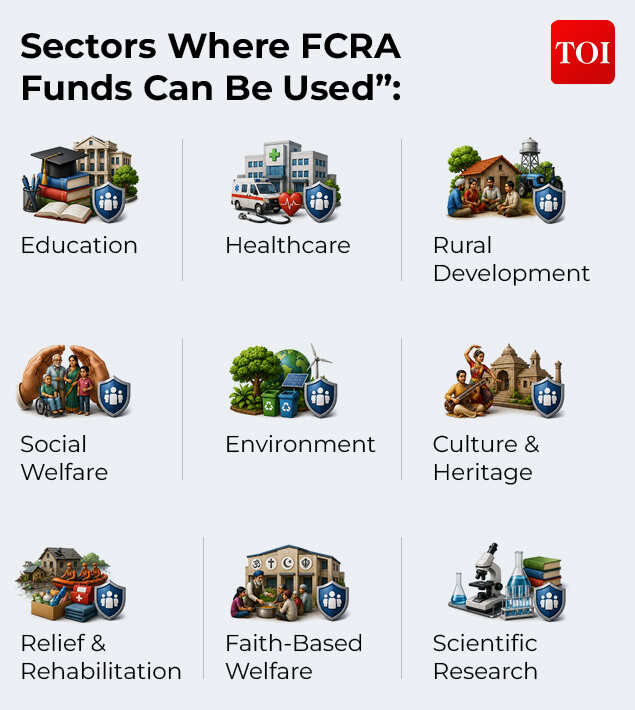
FCRA can be used in 9 different sectors
That is where the government’s reasoning and the opposition’s objections diverge. Under the proposed law, assets created using foreign contributions will vest in the “designated authority” not only when an organisation’s registration is cancelled or surrendered but also when it simply ceases because the registration was not renewed or the renewal application was rejected.The government argues this merely formalises an existing principle. It points out that the 2010 Act already provided for vesting of foreign-funded assets when an FCRA registration was cancelled or surrendered. According to the ministry of home affairs, the amendment only creates a detailed statutory framework explaining how those assets should be supervised, managed and disposed of, something that the earlier law did not spell out. It also says the initial vesting will be provisional and assets will be returned if the organisation later restores its registration.Critics, however, believe the practical consequences are far more significant. They argue that an organisation may have built a hospital, school or library years ago with foreign donations but may now be running it entirely through domestic funding. If such an organisation decides not to renew its FCRA registration because it no longer needs foreign contributions, the Bill could still result in those earlier assets vesting with the designated authority.PRS Legislative Research illustrates this concern through a hypothetical example of a healthcare organisation that built a hospital using foreign donations but later operated it entirely with domestic funds. Under the proposed framework, the hospital could still vest in the “designated authority” if the organisation’s registration ceased and was not restored. The authority would then have the power to transfer it to a government department or dispose of it.
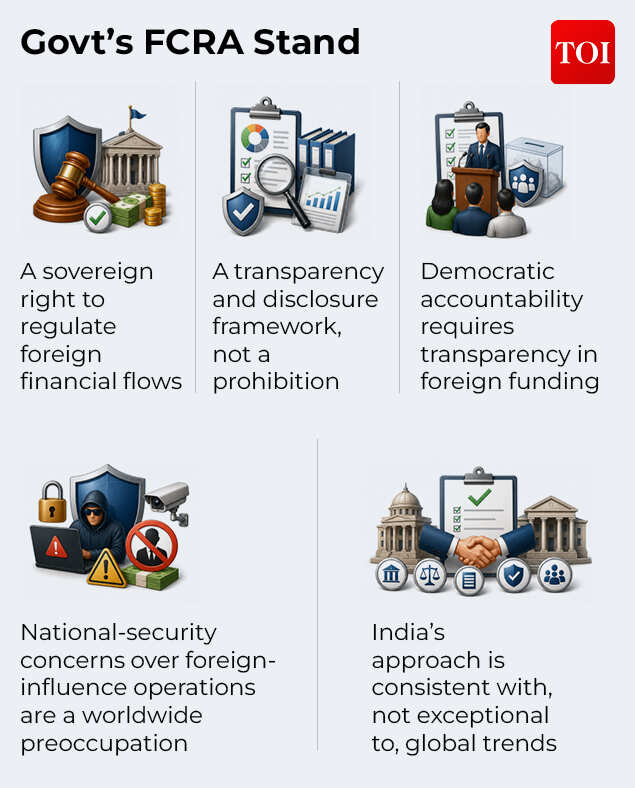
Government sees law as consistent with global trends.
Critics therefore argue that the amendment effectively creates no practical exit route from the FCRA system. An organisation wishing to retain assets originally built with foreign contributions may feel compelled to continue renewing its registration indefinitely, even if it no longer receives foreign funding. Another concern relates to mixed funding.The Bill says assets created wholly or partly through foreign contributions can vest in the designated authority. In cases where domestic and foreign funds have both been used to build an asset, organisations may apply to recover the identifiable domestic portion. Critics say that, in practice, separating domestic and foreign contributions within a single building or facility may not always be possible.While the existing law provides a mechanism to appeal against cancellation of an FCRA certificate, critics note that neither the Act nor the proposed amendment specifically provides an appeal against refusal to renew a certificate before the assets vest. They also point out that organisations are not guaranteed an opportunity to be heard before renewal is denied.
Why Christian organisations are worried
Although the Bill applies uniformly to all organisations, much of the opposition has come from church groups, especially in the Northeast.The Bill is not religion-specific, but church groups, particularly in Mizoram, have been among its most vocal opponents because many affiliated institutions receive foreign donations for welfare projects.Many churches and Christian charitable institutions receive foreign donations to run schools, hospitals, orphanages, homes for persons with disabilities and other welfare projects. Leaders fear that if their FCRA registrations lapse or renewal is denied, properties developed over decades using foreign contributions could eventually pass into government control. These concerns have been particularly strong in Mizoram.
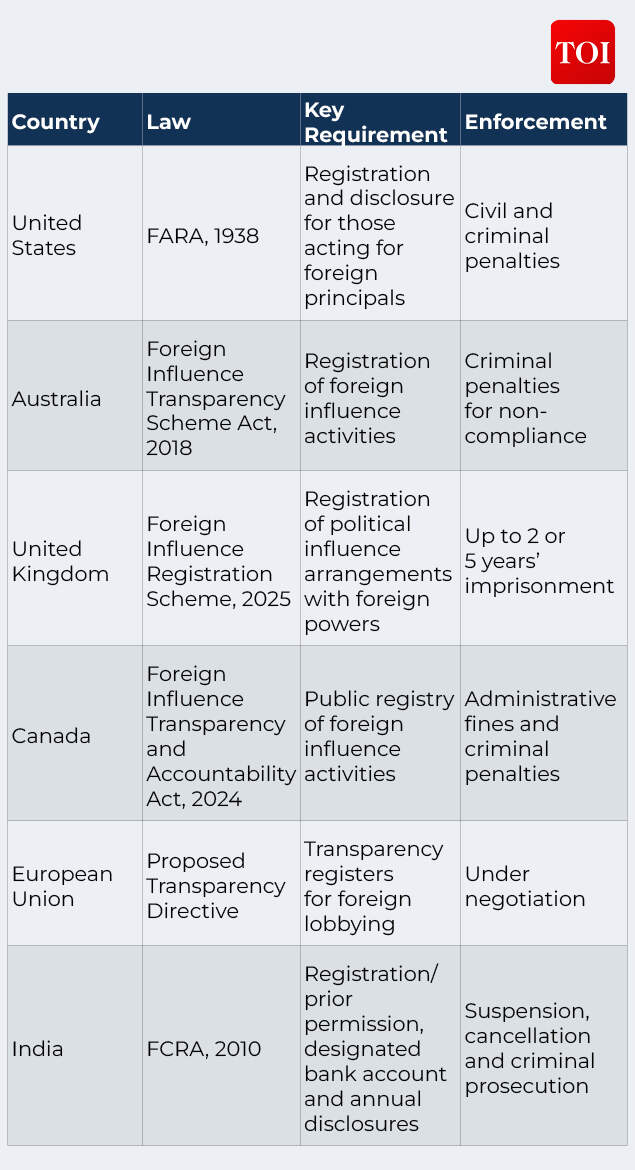
FRCRA like rules in different countries.
Chief minister Lalduhoma held consultations with leaders of the Council of Churches Mizoram and the Mizoram Kohhran Hruaitute Committee, after which it was decided that the provisions of the Bill “cannot be accepted in toto”. The state government resolved to prepare a memorandum suggesting changes and seek a meeting with Union home minister Amit Shah.Lalduhoma also said that if the Centre did not accept Mizoram’s suggestions, the state’s lone Lok Sabha MP from the ruling Zoram People’s Movement would oppose the Bill in Parliament.
Congress echos similar concerns
Congress’s Mizoram unit organised protests against the proposed amendment, alleging that Christian institutions would be adversely affected because many charitable organisations in the state depend on overseas donations. Former MP Chella Kumar alleged that the BJP was targeting religious and other minorities while exempting the RSS from the law’s purview. Church organisations elsewhere have also stepped up their campaign.Special prayer services were held across several churches following a call by the Joint Action Forum on Minorities to observe a National Day of Fasting and Prayer against the Bill. During one such gathering, DMK MP P Wilson compared the asset provisions with the Enemy Property Act and accused the government of targeting minority institutions. “The Enemy Property Act was enacted to snatch the properties of people who left the country after independence. Similarly, the FCRA Bill treats minorities as enemies and is keen on snatching their properties,” he said. A nationwide signature campaign and protests were also announced.
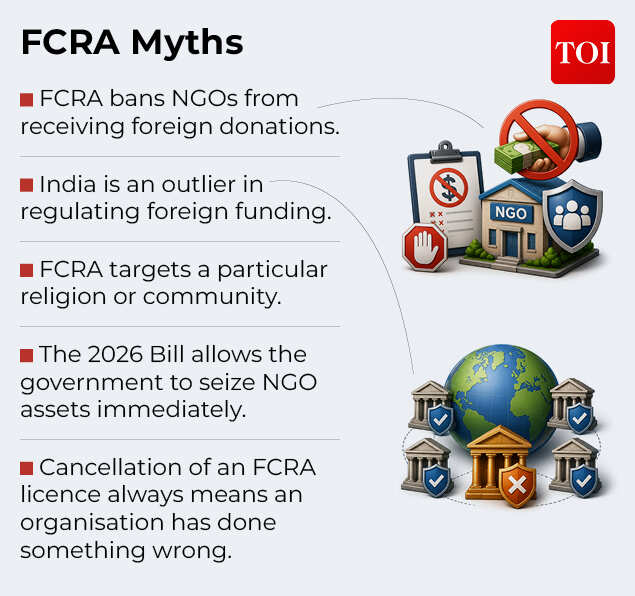
FCRA myths
The government’s response
The Centre has strongly rejected allegations that the amendment targets any particular religion or seeks to curb legitimate charitable work.According to the home ministry, around 16,200 associations received nearly Rs 22,963 crore in foreign contributions during 2024-25. The ministry cites these figures to argue that the FCRA regulates, rather than prohibits, foreign donations. It says organisations engaged in faith-based welfare activities remain eligible to receive foreign funding and that the law applies equally irrespective of religion, community or ideology. The government has also tried to address concerns over places of worship.The Bill requires the designated authority to preserve the religious character of any permanently vested asset, or part of an asset, that is a place of worship.
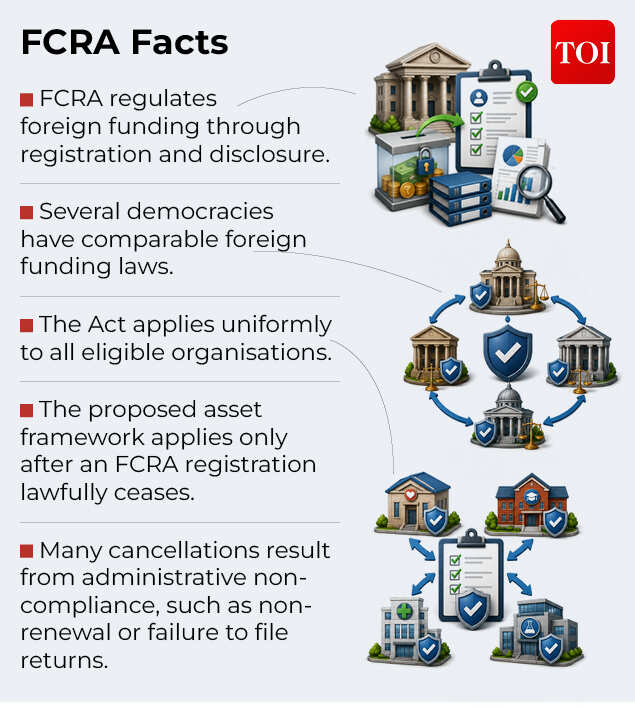
Govt’s clarification on FCRA
The government says the framework concerns foreign contributions and assets created from them after an organisation’s registration lawfully ends. The Bill, however, provides that an asset created partly with foreign contributions would initially vest wholly in the Authority, although the organisation may apply for the return of any distinct or ascertainable portion funded from domestic sources.The Centre has further defended restrictions on foreign nationals holding key positions in FCRA-registered organisations, arguing that organisations receiving overseas funding should be managed by individuals with a verified connection to India. Likewise, it said requiring central approval before state-level investigations is appropriate because the FCRA is a central law dealing with foreign funding and national security.