
For a patient facing end-stage organ failure, being told that a transplant may be required is only the beginning. The journey from a hospital referral to an actual transplant involves medical evaluation, registration, documentation, waitlist management, organ matching, allocation and, eventually, surgery and long-term follow-up.In India, the process is coordinated through a network involving the National Organ and Tissue Transplant Organisation (NOTTO), regional and state-level bodies, registered transplant hospitals and transplant coordinators.The scale of that system has changed sharply. In a February 2026 release, the Press Information Bureau said India recorded nearly 20,000 organ transplants in 2025, compared with fewer than 5,000 in 2013. More than 1,200 families donated the organs of loved ones after death in 2025, the release said.Yet the numbers tell only part of the story. Behind every transplant is a sequence that begins long before the surgeon enters the operating theatre — and, for the recipient, often long before an organ is ever offered. Notto’s says patients are evaluated by a multidisciplinary team, registered through a transplant centre, verified by the relevant allocation body and, once cleared, placed on the appropriate waiting list.
The process starts at the transplant centre
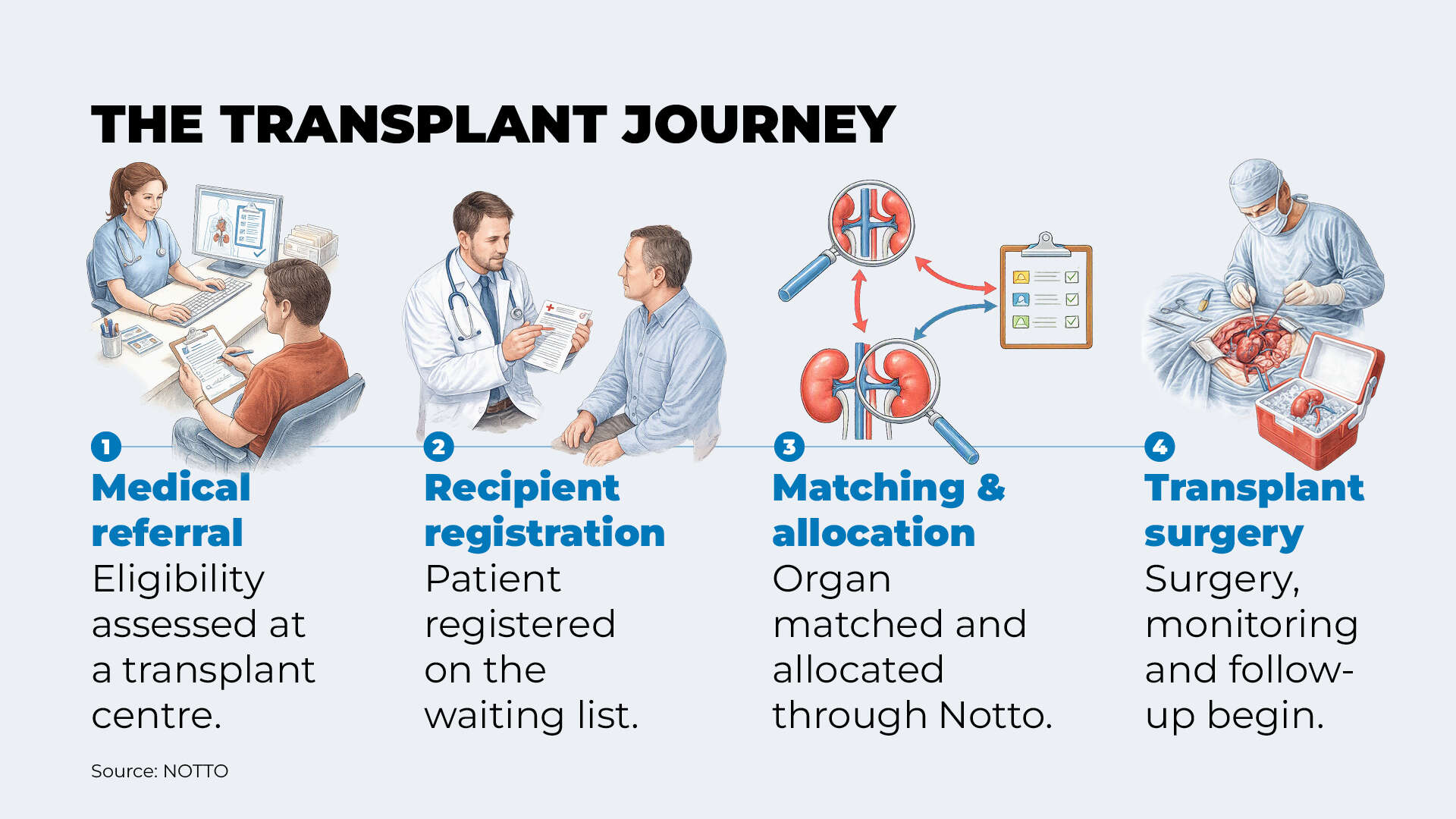
A patient with advanced organ failure is first referred to a licensed transplant centre. Doctors assess the underlying disease, the extent of organ damage and whether transplantation is medically appropriate.Not every patient with end-stage organ failure will necessarily be fit for transplantation.Talking about the initial evaluation before transplantation, Dr Manoj Gupta, senior director and HOD, liver transplant, Yatharth Super Speciality Hospital, said, “It typically includes a review of the patient’s medical history, physical examination, blood and tissue tests, imaging, assessment of organ function, infection screening and evaluation of any underlying conditions. Eligibility is determined by several factors, including the patient’s overall health, the extent of organ failure, surgical suitability, the likelihood of benefiting from transplantation and the ability to adhere to the post-transplant treatment regimen.”However, other factors can also determine eligibility. Dr Goutham Kumar, consultant, HPB & liver transplant services, SPARSH Hospital, added that eligibility also depends on the “absence of absolute contraindications, including active systemic infections, untreated malignancies, severe substance abuse or irreversible co-morbidities.”The hospital and transplant coordinator then compile the information required for registration.Once the application is accepted, the patient’s details enter the relevant transplant registry and waiting list. The waiting period can range from the same day to several years.
What being on the waiting list actually means
Being on a transplant waiting list is not simply being in a queue. Notto says patients are listed according to medical criteria, with regular and urgent categories, while priority varies by organ. For kidney transplants, time on regular dialysis is among the factors considered; other organs follow different criteria.Dr Kumar explains how these organ-specific criteria work in practice, “Liver allocation often uses the MELD (Model for End-Stage Liver Disease) score, while heart allocations prioritize patients on mechanical support. Pediatric patients and high-urgency acute cases frequently receive priority.”Notto’s manual also provides for urgent or “Priority One” categories for patients meeting organ-specific requirements. Such cases may be reviewed by an expert committee before priority is granted, with hospitals required to provide regular clinical updates.Registration does not freeze a patient’s status. Their medical condition continues to be monitored and records updated. Depending on their health, a patient may remain active, be made inactive or become medically unfit for transplantation.
When a donor organ becomes available
The next turn in the journey comes when an organ becomes available. It may come from a living donor, commonly a kidney or part of a liver, or from a deceased donor after certified brain-stem death. At that point, Organ India says, “the transplant coordinator of the hospital will counsel the family and give them the option of donating organs and tissues.”The next of kin must consent before retrieval. That makes a donor pledge only at the beginning of the conversation. Organ India puts it plainly: “In India it’s more important to talk to your family about your decision than it is to pledge your organs and get a donor card.”Once a donor organ is identified, a rapid, highly coordinated race against time begins. Blood group compatibility and cross-matching are verified between the donor and potential recipient, while the organ is assessed for suitability.Dr Kumar explains, “A surgical retrieval team harvests the organ and preservation solution is administered. Transport logistics—often utilising dedicated ‘green corridors’ or air transport—are activated to move the organ immediately.”The recipient is called to the hospital, re-evaluated and prepared for surgery, with the surgical team ready to proceed as soon as the donor organ arrives.
From brain-stem death to retrieval
A deceased donor is medically maintained while permissions and retrieval arrangements are completed, helping preserve viable organs until they can be recovered. Once retrieved, however, the clock begins to run: each organ has a limited preservation window.
India’s transplant numbers are rising
The national system has expanded significantly over the past decade.The ministry said more than 1,200 families came forward to donate the organs of loved ones after death in 2025.“More than 4.8 lakh citizens have registered to donate organs and tissues after death through a Aadhaar based verification system, since 17th September 2023,” the PIB release said.The release also said India had developed expertise in complex heart, lung and pancreas transplants and claimed the country “leads the world in hands transplants and performs a greater number of hand transplants than any other country.”The government said the increase reflected improvements in deceased donation, transplant coordination and national organ sharing.
The gap between demand and supply remains
Even after surgery, the process continues. Recipients need lifelong follow-up and immunosuppressive medication, which can also carry long-term risks.Dr Jagriti Yadav, medical director – lab operations, Cryoviva Life Sciences, said, “The major long-term risks include acute or chronic graft rejection, opportunistic infections, cardiovascular complications, kidney toxicity, and metabolic side effects related to immunosuppressive medicines.”The increase in transplant numbers has not eliminated the shortage of organs.
Foreign recipients are also part of the system
India’s transplant system also treats foreign nationals, subject to additional safeguards. Government guidance says an Indian living donor may donate to a foreign recipient only if they are near relatives; donors must be at least 18, with medical-visa and registration requirements applicable to both parties.
Share your thoughts in the comments
Be respectful · TOI community guidelines
The next stage is a more connected transplant system
India’s transplant system is becoming more digitally connected, with national coordination and data-sharing expanding alongside transplant numbers. Aadhaar-verified donation registrations crossed 4.8 lakh, while nearly 20,000 transplants were recorded in 2025.The next challenge is ensuring potential donors are identified, families counselled and organs retrieved, transported and allocated efficiently. For recipients, that means staying medically fit, updating the transplant centre and following clinical advice.