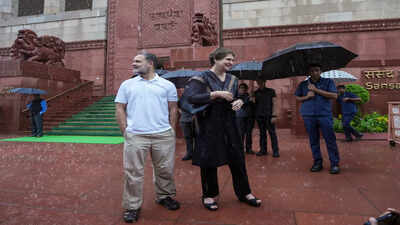
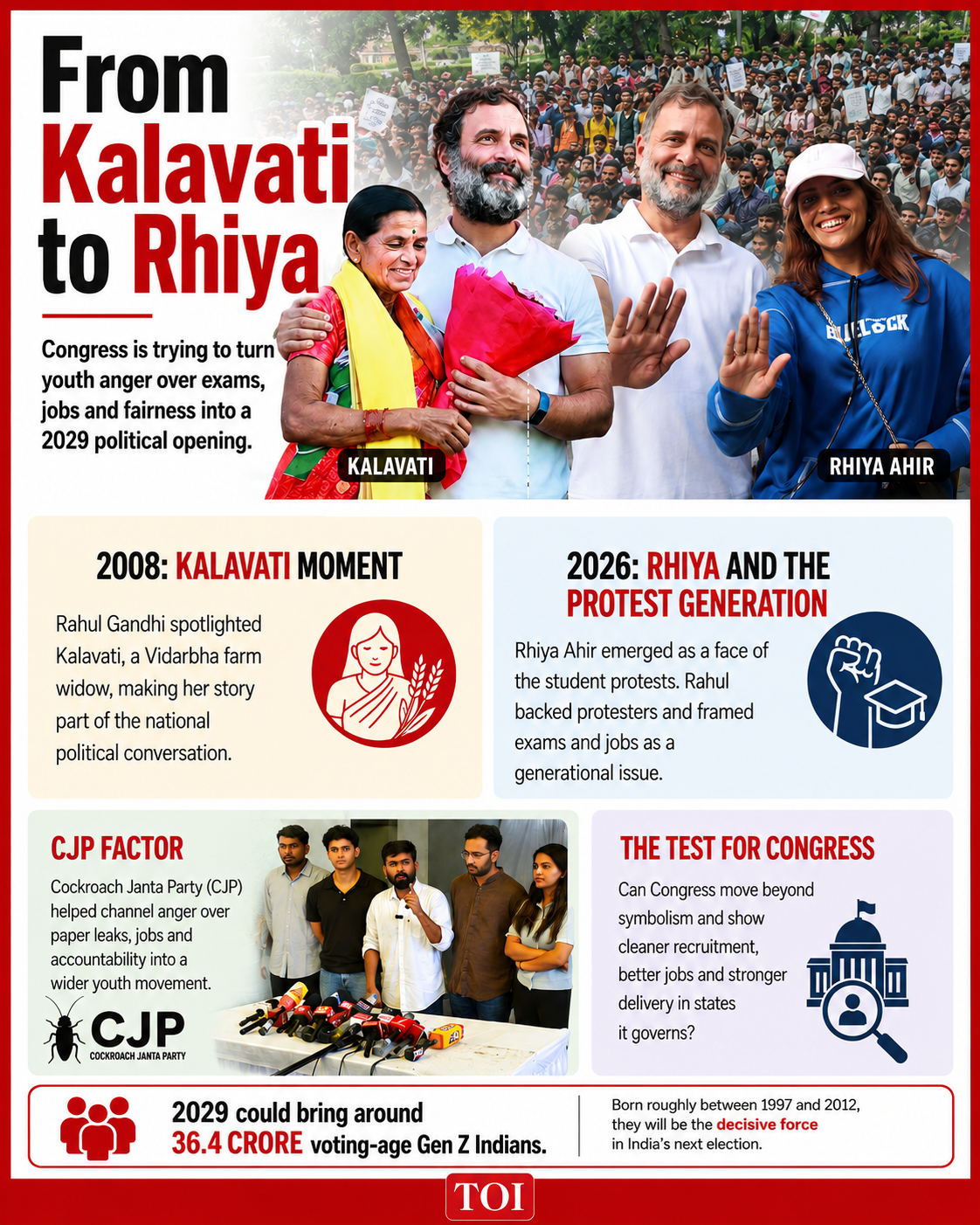
Rahul Gandhi‘s interaction with Kalavati went viral in 2008, back when “viral” meant something very different. The widow of a farmer who died by suicide, she was raising nine children in Vidarbha when Rahul met her, and he later invoked her life in Parliament during the Indo-US nuclear deal debate.Eighteen years later, the Leader of Opposition stood beside Rhiya Ahir, the 27-year-old Mumbai woman who became a social-media sensation during the student protests after standing in front of a police van carrying detained protesters.Between those two moments, an entire generation grew up and largely walked away from the Grand Old Party in search of achhe din. Broadly speaking, Congress lost the millennials in large parts of the country, barring the South. Now, as anti-incumbency gradually catches up with the ruling regime, Congress is looking at a fresh crop of voters who could form a decisive electoral bloc by 2029.Rahul’s communication strategy over the past month has laid out the approach clearly. From an unparliamentary expression inside Parliament that was later expunged, to telling protesting students they did not need to apologise to the prime minister, to an Instagram outreach mixing serious student questions with playful jibes at “Amarinder Uncle”, the attempt to speak Gen Z’s language is unmistakable.Former Congress leader Sanjay Jha, speaking to TOI, said he believes Rahul’s natural lingo is more attuned to Gen Z than Modi’s. He says the prime minister’s recent Instagram outreach came across as condescending to sections of young users, while Rahul seems more natural. Jha is categorical, according to him, Rahul represents the future and Modi the past.Despite successive Assembly victories after its underwhelming 2024 Lok Sabha performance, the BJP suddenly appears to be on a slightly sticky wicket. The NEET agitation has claimed a high-profile political scalp, a rarity in this government. For Rahul, it is a no-brainer to cash in on that advantage.
The generation that got away
The generation that was in its 20s and early 30s during the 2014 election firmly reposed its faith in the BJP or, more specifically, in Narendra Modi. His appeal as an outsider breaking through Delhi’s entrenched power elite resonated with aspirational young voters. The pitch around development, technology, entrepreneurship and muscular nationalism continued to reap dividends election after election.An analysis of Lokniti-CSDS National Election Study data shows BJP support among voters aged 18-25 rising from 34% in 2014 to 41% in 2019. Congress remained stuck at 19%. The personal gap was even wider, with 51% of young respondents preferring Modi as prime minister in 2019, against 23% for Rahul.The BJP did more than defeat Congress among the young; it captured their imagination about what the future could look like. By 2024, however, a subsequent Lokniti-CSDS analysis found that no party had succeeded in carving out a distinct youth constituency. That churn is precisely what makes 2029 interesting.The beauty of democracy is that there is always a fresh test after five years. The next general election can be a very different proposition, or at least that is what Congress would hope.
The 36-crore election
By 2029, Gen Z will be far from a niche constituency.Using the common definition of Gen Z as those born between 1997 and 2012, its voting-age members in 2029 will be roughly 18 to 32 years old. An interpolation of the National Commission on Population’s 2026 and 2031 age-group projections suggests India could have around 36.4 crore people in the voting-age Gen Z cohort by then. These are projected people of voting age, not registered electors, and actual turnout will obviously be lower.The arithmetic is still striking. Uttar Pradesh could have around 6.65 crore Gen Z adults in 2029, Bihar 3.73 crore, Maharashtra 3.18 crore, West Bengal 2.40 crore, Madhya Pradesh 2.34 crore and Rajasthan 2.25 crore. Gujarat could have 1.86 crore, Tamil Nadu 1.67 crore, Karnataka 1.63 crore, Andhra Pradesh 1.22 crore, Odisha 1.15 crore and Telangana around 92 lakh.
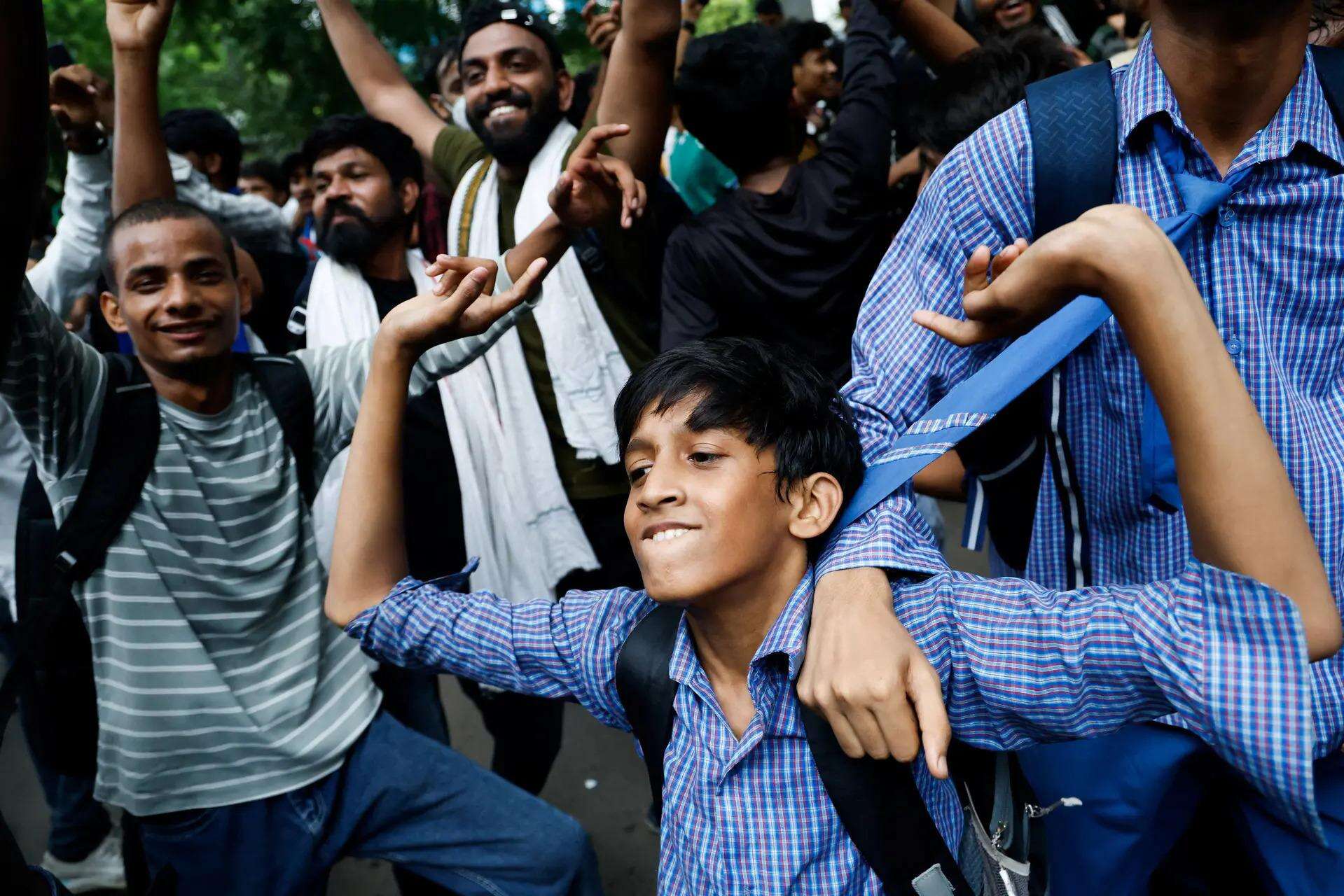
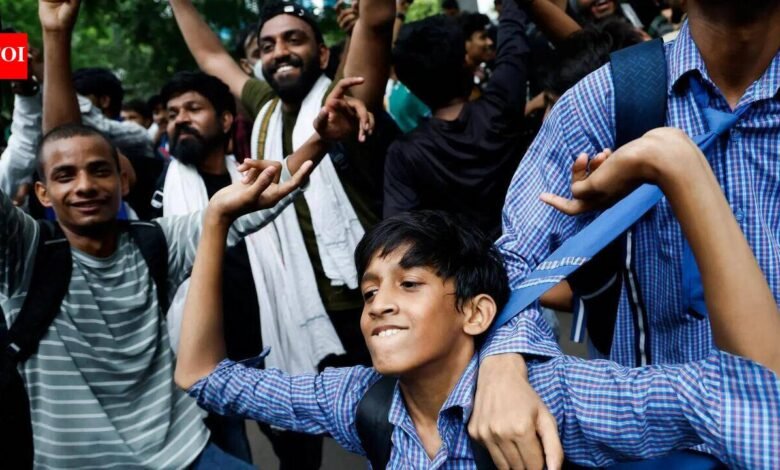
Supporters of Cockroach Janta Party (CJP) celebrate after Dharmendra Pradhan resigned
Together, these 12 states could contain nearly 29 crore voting-age Gen Z Indians. On the current electoral map, they account for 420 Lok Sabha seats, though delimitation could change that arithmetic before 2029.Awkwardly for Congress, it remains organisationally weak in several states where the Gen Z pool will be largest. Uttar Pradesh and Bihar alone could contain more than 10 crore Gen Z adults. Instagram can reach these voters, but holding on to them requires organisation.Telangana chief minister A Revanth Reddy has taken the outreach a step further, proposing that the minimum age to contest Lok Sabha and Assembly elections be lowered from 25 to 21, and that for the Rajya Sabha and legislative councils from 30 to 25.But the question comes back at Congress. Even if the legal age is lowered, will it actually give tickets to 21-year-olds?
The break Congress could not manufacture
The party has been trying, with limited success, to get into the youth mind space for years. Rahul’s campus visits, student conversations, attacks on unemployment and repeated interventions on paper leaks all predate the present protest cycle.The Bharat Jodo Yatra tried to remake Rahul as a leader who would walk and listen rather than merely speak. The Bharat Jodo Nyay Yatra before the 2024 election sharpened that pitch. That eventually became the five-part Yuva Nyay offer. Yet it did not acquire a life beyond the election cycle. There was no large youth groundswell speaking the language of Yuva Nyay. Like many Congress programmes, it was launched, discussed and eventually sank without a trace.The Cockroach Janta Party began as a satirical, digital-first intervention with what old political parties lacked: irreverence, little legacy baggage and a vocabulary born on social media. It gave accumulated frustration a conduit. Online anger over examination leaks spilled onto the street and widened into a protest over education costs, employment and institutional accountability. For Congress, this was the break it had spent years trying to manufacture but failed to produce.Jha offers perhaps the sharpest explanation for why CJP succeeded where conventional opposition parties struggled. The Modi government, he argues, can use agencies and the coercive power of the state to pressure political adversaries. It can also resort to what he calls “convenient whataboutery” about 60 years of Congress rule. Students have fewer institutional or political stakes that can be turned against them, and familiar political labels do not work on them, according to Jha.
The challenge in front of Congress
The opposition, he says, failed to galvanise frustration that has now “erupted like a volcano”. A party serious about youth politics, he asks, must also explain why the NSUI and Youth Congress were not present at Jantar Mantar in much larger numbers.Political expert Subhamoy Maitra sees the emergence of figures like Abhijeet Dipke as evidence of a wider leadership crisis in mainstream political parties. Ashutosh Chatterjee, general secretary of the West Bengal Pradesh Congress and a former student leader, rejects that charge. Leaders are not “propped up”, he argues; those who consistently echo public sentiment eventually get recognition. He cites Kanhaiya Kumar, Manish Sharma and Vinod Jakhar among Congress’s next generation and credits Rahul’s Chhatra Ki Goonj with helping catalyse the student movement. He is categorical that there is no dearth of talent in Congress.Rahul has meanwhile walked a tightrope with CJP, amplifying the issues, raising them in Parliament and meeting protesters while keeping a measured distance from Dipke and the core leadership. Congress wants to latch on to the momentum without getting directly associated with it, believes Maitra. Since the leaders of CJP are relatively unknown, he argues, it makes more sense for Rahul Gandhi to share a stage with the likes of AISA’s Neha Bora. With Sonam Wangchuk revealing that Rahul Gandhi even declined to break his fast, it is clear that the Congress leader is trying to keep the protesters at arm’s length.Political scientist and former Calcutta University registrar Dr Rajagopal Dhar Chakraborti believes the NEET agitation was unusual because it organically brought sections of Gen Z together around a wider sense of institutional failure and caught the government off guard. Students, he agrees with Jha, have little to lose and are harder to intimidate.But Dr Chakraborti doubts Congress can simply inherit the dividend. CJP, he suggests, could eventually test the electoral waters itself rather than hand its constituency to any established party. He echoes the sentiments of Prashant Kishore that Bankipur result too is an indication of the mood inside the Gen Z constituents.
Jobs may be the bigger trigger
The World Bank estimates that around 11 million young Indians will enter the labour market every year over the next two decades. Increasingly, the crisis is about the quality of employment, not just its availability. The gig economy cannot be a panacea for an increasingly educated and aspirational society. For decades, the implicit social contract was simple: a higher-education degree would culminate in a well-paying job. That notion is now under stress.AI, automation and other macroeconomic pressures could sharpen the mismatch. If India produces ever larger cohorts of graduates but a disproportionate share of new work remains temporary, informal or low-productivity, education itself could become a source of discontent. Congress leader Chatterjee believes that the combination of unemployment, recurring paper leaks, shrinking space for public education and growing commercialisation of education will eventually push younger voters towards Congress. He says Congress can offer Gen Z “total transparency”.
Can Congress states offer an alternative?
States do not control the entire macroeconomy, but they still have a large role to play in shaping the future of Indians, especially in areas like education, which is on the Constitution’s Concurrent List. Jha believes Congress needs an alternative model of governance where performance can speak for itself. He earmarks states like Karnataka and Kerala that could effectively be projected as models of governance.But the inferno of student unrest has the potential to spill into opposition-ruled states, as Jharkhand is showing.Congress is a partner in the JMM-led government, where students and government-job aspirants have protested alleged irregularities involving JPSC and JSSC recruitment examinations. Rahul Gandhi, to his credit, has addressed the issue head-on, describing the education system as having “collapsed” and become expensive and oppressive.More importantly, he refused to exempt governments involving his own party, saying every government, including the one in Jharkhand, should listen to students and act.
From Rajiv’s computers to Rahul’s paper leaks
Congress has travelled this road before.NSUI channelled students into party politics, and Youth Congress provided the next rung. Rahul himself has spent almost two decades trying to build a younger political layer, with limited gains. Across large parts of India, the party remains top-heavy.Dr Chakraborti turns almost wistful recalling how Rajiv enthused younger Indians before getting bogged down by a coterie of older Congress hands. Rajiv Gandhi once captured the young imagination far more successfully. In a pre-liberalisation India, computers and telecommunications became symbols of a future arriving early. His government also lowered the voting age from 21 to 18.The recent NEET debate in Parliament showed how Rahul and Priyanka Gandhi are operating. Rahul sought to legitimise student anger without claiming ownership of it. He told Parliament that Indians should be proud of the protesters, described students as people willing to question and keep their minds open, and called an expensive and commercialised education system an “extortion system”.Priyanka spoke about injured students, asked whether protesters were “terrorists”, and delivered a sharp line: if the prime minister wanted to win them back, he needed to change the “angle of his heart”, not the camera angle.
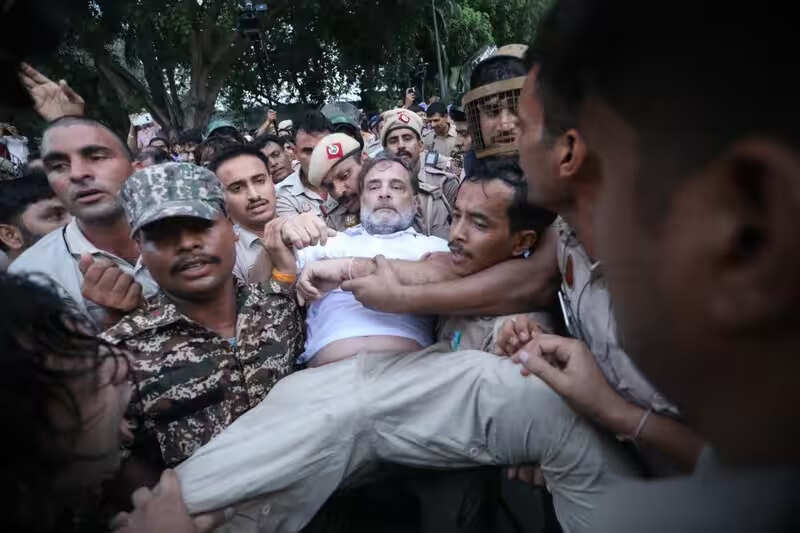
Rahul Gandhi protesting in front of PM Modi’s residence
Gen Z doesn’t owe its vote to anyone
Political pundit Subhamoy Maitra offers the necessary caution.It is far from clear, he says, how protest politics translates into electoral democracy. Barring movements such as Anna Hazare’s anti-corruption agitation and the RG Kar protests, relatively few civil-society uprisings have produced durable electoral consequences in the last decade and a half. He also believes Rahul still needs to shed the perception of being a “part-time politician”. Chatterjee rejects that description, asking when a Leader of Opposition had previously had to shed blood while standing with protesters, as Rahul did during the NEET agitation.
Share your thoughts in the comments
Be respectful · TOI community guidelines
For all the marketing jargon, Gen Z is not one homogeneous political community. Caste, religion, region, class and gender will not disappear merely because everyone uses Instagram. Students can welcome Rahul as an amplifier and still refuse to accept him as their leader. CJP has already shown that young Indians can organise outside both the ruling party and the established opposition. The party has already announced its next campaign ” Kya Bolti Public”. Dr Chakraborti believes that this may well be a precursor to CJP testing waters in next year’s Uttar Pradesh elections.Gen Z content creators often harp on one word, which is consistency. That, they say, is what eventually produces organic reach. Rahul Gandhi might want to borrow the lesson, believes Sanjay Jha. Between Kalavati and Rhiya Ahir, Rahul Gandhi has toiled hard, often without much to show for it. Maybe that is because the party is yet to fundamentally establish how a Congress-ruled India would be different. That targeted messaging and, more importantly, tangible execution will be crucial.Nearly 36 crore young Indians could be up for grabs in 2029. Sooner or later, they will ask what actually changed after they were heard.